Work · Robotics
robotics-lab.
A rosbag or a CAN trace goes in. Rates, latency and jitter come out. Two paper methods run in simulation.
The problem
The rate, the latency, and the equations, on the same bench.
Imagine a joint loop on the bench: a sensor, a controller, a plant. You want the topic rate, the end-to-end latency, the jitter, and the same measurements on the CAN traces that travel with it — and, next to those, a chance to run the paper methods you are reading, from the published equations, in simulation.
The useful result is a report you can check against the bag, plus two paper methods — discrete dynamic movement primitives and iterative LQR — that run from those equations.
What we built
A report on the bag, and two paper methods in simulation.
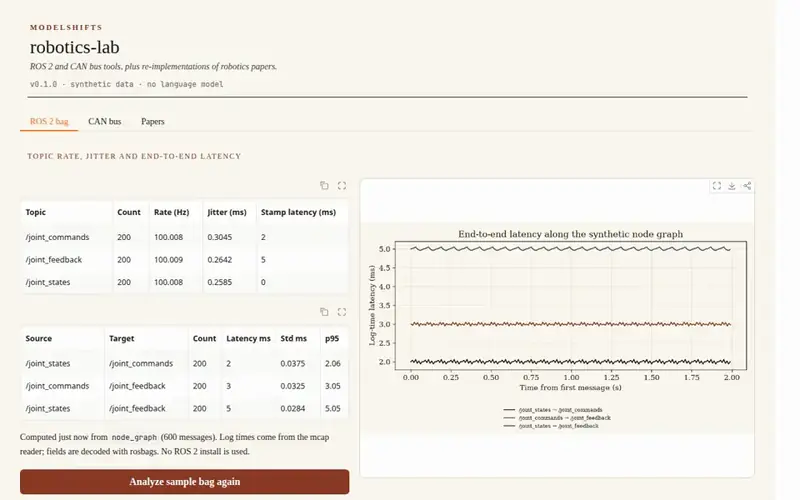
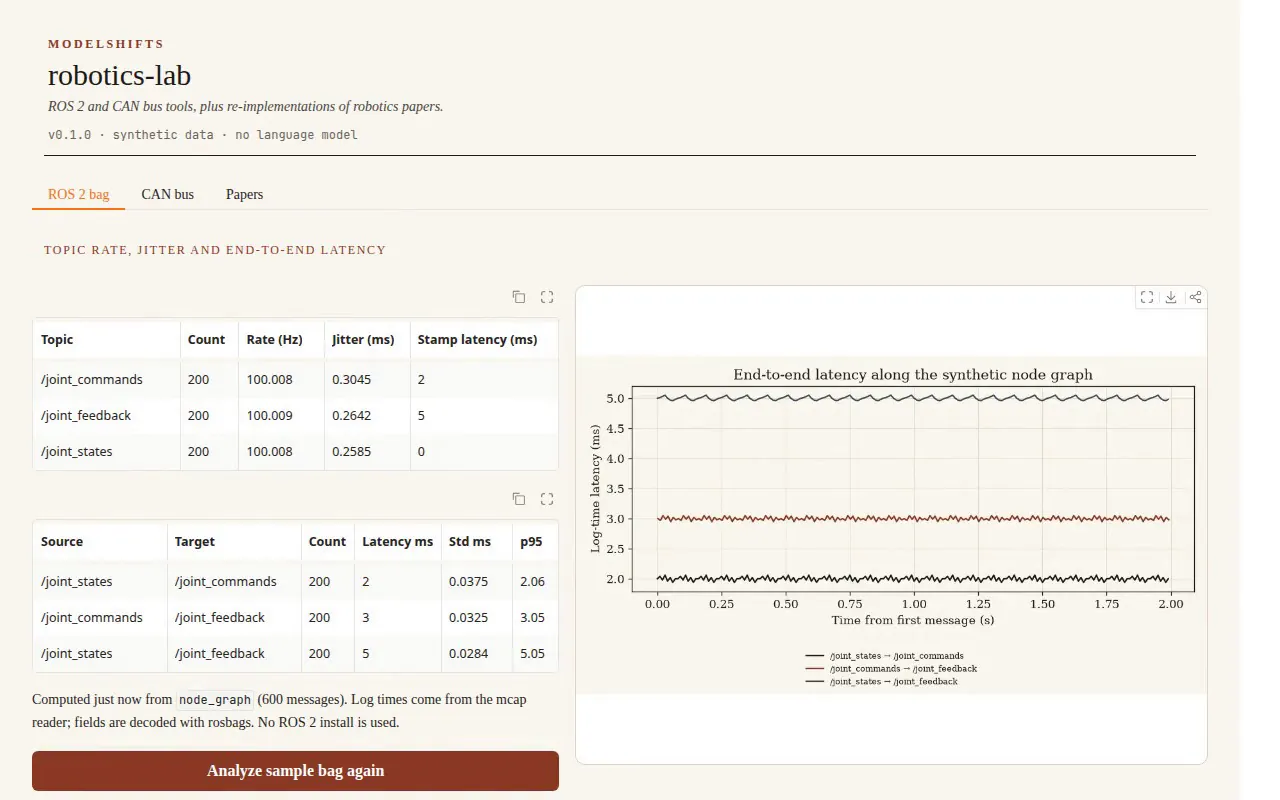
Three tools, and no language model. A rosbag2 (mcap) of a node graph is analysed for topic rates, inter-arrival jitter and end-to-end latency, matched on header.stamp. Reading the bag does not need a ROS 2 install. A CAN trace is decoded with a DBC and scored the same way. Discrete DMPs (Ijspeert et al., 2013) and iterative LQR (Li and Todorov, 2004) run in simulation. You get the report and the paper figures.

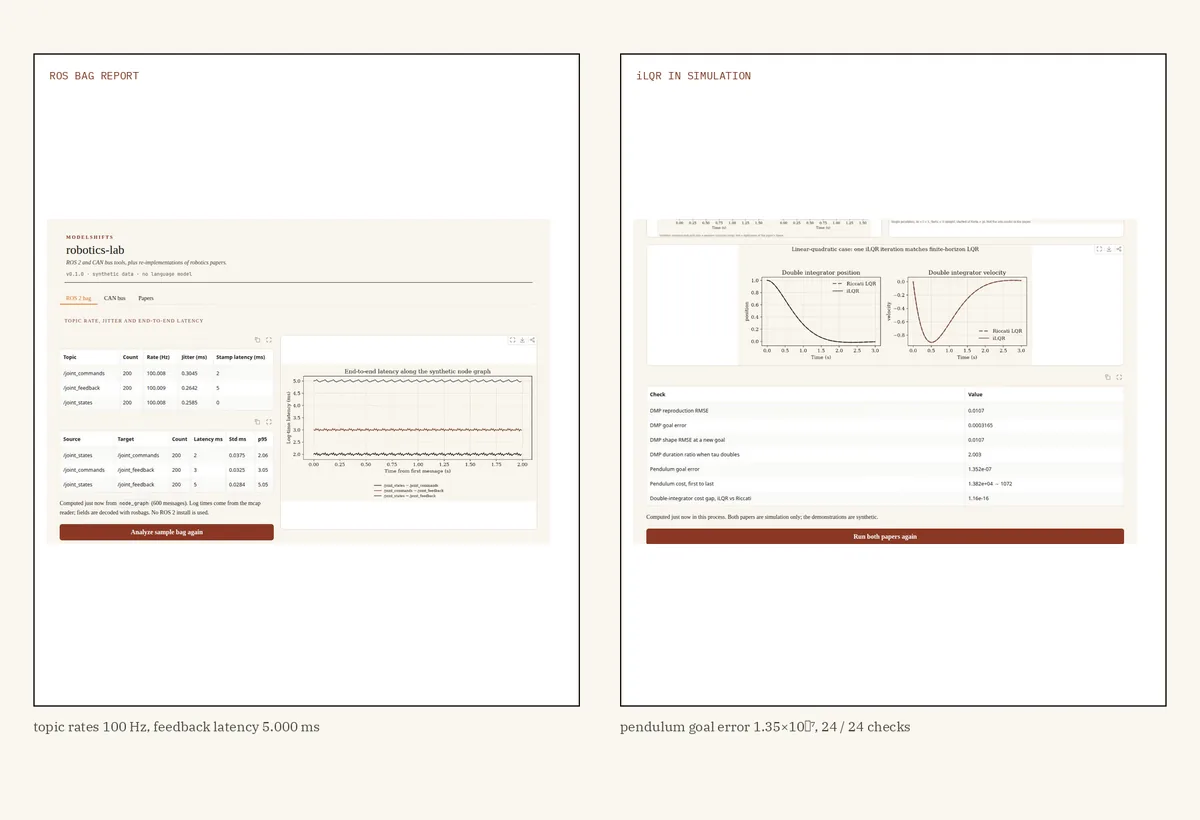
A latency number without the bag it came from is a rumour. A report matched on header.stamp, next to the same measurements on the CAN trace, is a claim you can check — and the paper figures are a chance to run the equations, not only to look at a plot from the PDF.
Results
24 of 24 checks passed, against the generator settings.
-
24 / 24
Checks passed
-
12 + 5 + 7
ROS · CAN · papers
-
100 Hz
Topic rate, matched stamps
On the rosbag, the CAN trace, and the two paper methods in simulation, scripts/evaluate.py passed 24 of 24 checks against the generator settings: 12 ROS, 5 CAN, 4 DMP and 3 iLQR.
| Group | Passed | Highlights (measured) |
|---|---|---|
| ROS bag (12) | 12/12 | Topic rates 100.007–100.009 Hz (expected 100.0 ± 0.02). Stamp latencies 0, 2.000000 and 5.000000 ms. Edges 2.000000, 3.000000 and 5.000000 ms (n=200). |
| CAN (5) | 5/5 | 600 frames, unknown 0. Bus load 0.081199 (expected about 0.081). Edges 2.000000, 3.000000 and 5.000000 ms. |
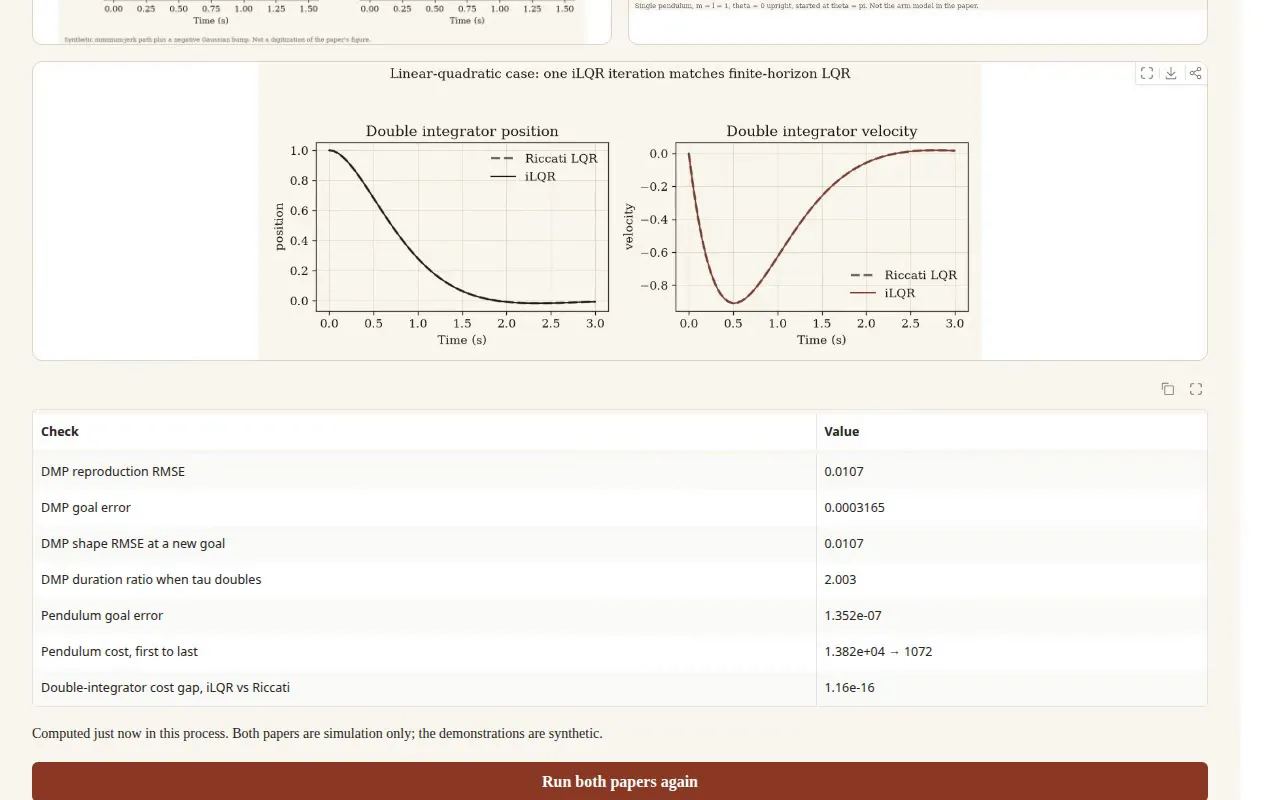
| DMP (4) | 4/4 | Reproduction RMSE 0.01072, goal error 0.000316, shape RMSE at a new goal 0.01072, time-scale ratio 2.0027. |
| iLQR (3) | 3/3 | Cost 1.382×10⁴ → 1072 in 6 steps, monotone. Pendulum goal error 1.35×10⁻⁷. Riccati relative cost gap 1.16×10⁻¹⁶ on the double integrator. |
| All | 24/24 |
Methodology. The thresholds are the generator settings (or a bound around them). The rosbag is a pure-Python simulation of a joint sensor, a controller and a plant; the CAN trace is decoded with the committed DBC. DMP follows Ijspeert et al., Neural Computation, 2013, on a minimum-jerk path plus a negative Gaussian bump. iLQR follows Li and Todorov, ICINCO 2004, on one pendulum. python scripts/evaluate.py, 12 November 2026. The raw table is in docs/eval.md. The script is scripts/evaluate.py; the samples are in samples/.
The full 24-row table is in docs/eval.md.
Run it yourself
Three commands, then the demo.
git clone https://github.com/ModelShifts/robotics-lab
cd robotics-lab && python -m venv .venv && source .venv/bin/activate
pip install -e ".[demo]" && robotics-lab serve
There is no language-model backend and nothing to download from Hugging Face. Python 3.11 or newer.