To evaluate an AI vendor, test their system on a hidden sample of your own real cases, inside a sandbox that mimics your systems, with pass criteria you wrote before seeing any results. Run every case several times, grade the end state of your systems rather than what the agent says it did, and check the cases where it should refuse or hand over as carefully as the ones where it should act. Then compare vendors on consistency, failure behaviour, and cost per accepted outcome, not on a benchmark score or a demo. A few weeks of this work is cheap next to a year-long contract for the wrong system.
In short:
- Vendor benchmarks and demos measure someone else’s problem; a hidden test set drawn from your own work measures yours.
- Write the pass mark and the hard gates down before any vendor runs a single case.
- Run each case three to five times. Report the worst run and the share of cases that pass every time, not just the average.
- Grade outcomes in your systems, and check the trajectory for actions the agent should never have taken.
- Rank vendors on cost per accepted outcome only after the hard gates pass.
What does it mean to evaluate an AI vendor on your own data?
An evaluation is a repeatable test: give the system an input, then apply grading logic to decide whether the result counts as success. A holdout set is a sample of your real cases that the vendor never sees before the test, so it cannot be tuned against. A trial is one attempt at one case; because AI outputs vary from run to run, a fair test runs several trials per case. An outcome is the final state of your systems after the trial: Anthropic’s engineering guidance on agent evals makes the point with a flight-booking agent, where success is whether the reservation exists in the database, not whether the agent said “your flight has been booked” (Anthropic, January 2026).
Put together, a buyer-side evaluation is a small, controlled rehearsal of the job you are hiring the system to do. It is narrower than a pilot, because it needs no live users, and stricter, because the vendor does not choose the examples.
Why can’t you trust a vendor’s benchmark scores or demo?
A benchmark score is an exam result. You are hiring for a job. Exams are useful when the questions are secret and resemble the work. Both conditions erode once a test becomes famous: its tasks can enter training data, and developers tune their systems against it.
The erosion is measurable. Scale AI researchers rebuilt the GSM8k maths benchmark as a fresh, human-written set of matched difficulty and found accuracy drops of up to 8% for some model families, with evidence of systematic overfitting, although frontier models showed little sign of it (Zhang et al., arXiv 2405.00332). A sharper example arrived last month. MaxxBench takes 89 tasks from the DeepSWE coding benchmark and makes small requirement changes of the kind a reviewer might ask for, such as lowercase report filenames; the reference fixes grow by a median of only 17 lines. Six model configurations that sat within 1.5 points of each other near 74% on the original tasks fanned out across 23 points on the modified ones (MaxxBench, October 2026, updated 6 November 2026). Kaggle independently re-ran ten of the models and landed within 0.4 points of the published average (Kaggle MaxxBench leaderboard). The authors’ reading of the transcripts is the part buyers should remember: many models guessed what the hidden tests wanted and coded to that guess instead of to the stated requirement.
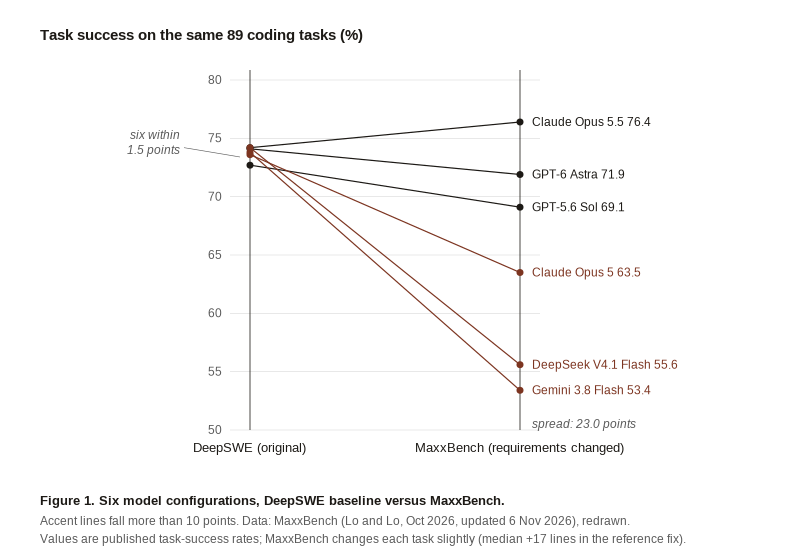
Your workflow is the modified version: your invoices and policies are in no benchmark, and the rules that matter most are often the small exceptions. In the Global AI Assurance Pilot run by IMDA and the AI Verify Foundation, which paired 17 organisations deploying generative AI applications with 16 specialist testing firms, off-the-shelf benchmark datasets were rarely used except for content safety in external-facing applications; use-case-specific test sets were the norm (AI Verify Foundation, 2025).
Demos have the opposite problem. They are honest about the examples shown and silent about the examples chosen.
How do you build a fair test on your own data?
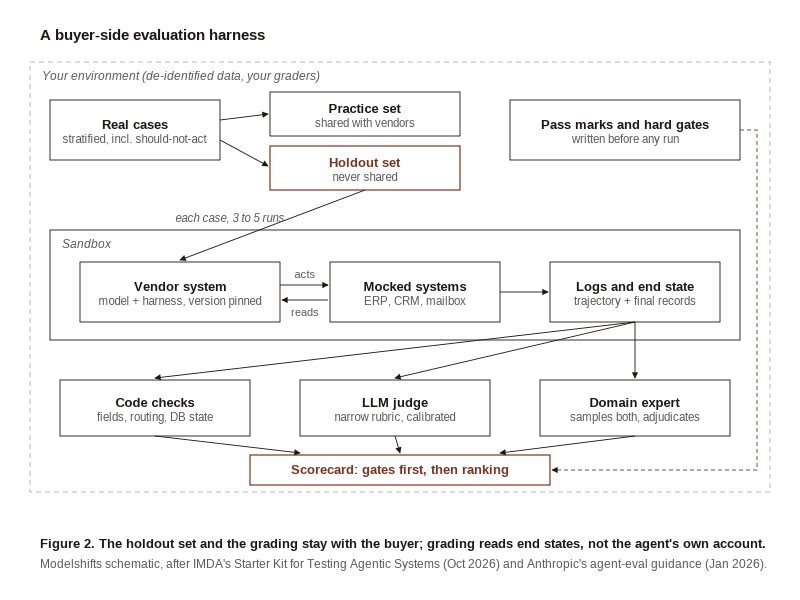
The method below borrows from IMDA’s two testing starter kits and published agent-evaluation practice. For a single workflow it fits in one to three weeks.
Define the business action and its end state
Start from the decision the system will make or the record it will change: route an email, post invoice fields to the ERP, approve or escalate a refund. Write down what a correct end state looks like. If you cannot say what “done correctly” means for a case, neither can a grader.
Sample real cases, including the ones where it should not act
Pull recent real cases and stratify them: routine volume, known hard cases, and cases that should be refused, escalated, or left alone. Anthropic’s guidance warns that one-sided test sets produce one-sided systems, so include both cases where a behaviour should happen and cases where it should not. It also suggests that 20 to 50 tasks drawn from real failures is a good start when effects are large (Anthropic, 2026). For a vendor comparison we prefer a few hundred cases split into two sets: a small practice set you share so vendors can configure their system, and a larger holdout set they never see.
Write the pass mark before anyone runs a case
IMDA’s Starter Kit for Testing LLM-Based Applications (version 1.0, January 2026) says each organisation must set its own threshold before testing, which “prevents ‘moving goalposts’ after seeing the results.” It also distinguishes ordinary thresholds from hard gates: risk scenarios linked to severe or irreversible harm where even rare failures are unacceptable (IMDA, January 2026, section 3.1.4). In business terms, a hard gate is “never pays a supplier whose bank details changed this week without a human” or “never sends a customer another customer’s data.” One failure on a hard gate fails the vendor, whatever the average.
Run it in a sandbox that looks like your systems
An agent that can act needs somewhere safe to act. IMDA’s Starter Kit for Testing Agentic Systems, released on 14 October 2026, recommends starting in contained but realistic environments, mocking tools and external services where feasible, and moving closer to production only as confidence grows (IMDA, October 2026). It adds a detail that matters for test design: agents are sensitive to signs that they are in a simulation, such as placeholder names like “John Doe,” and may behave differently. Use realistic, de-identified records, not lorem ipsum.
Repeat every case, and look at the worst run
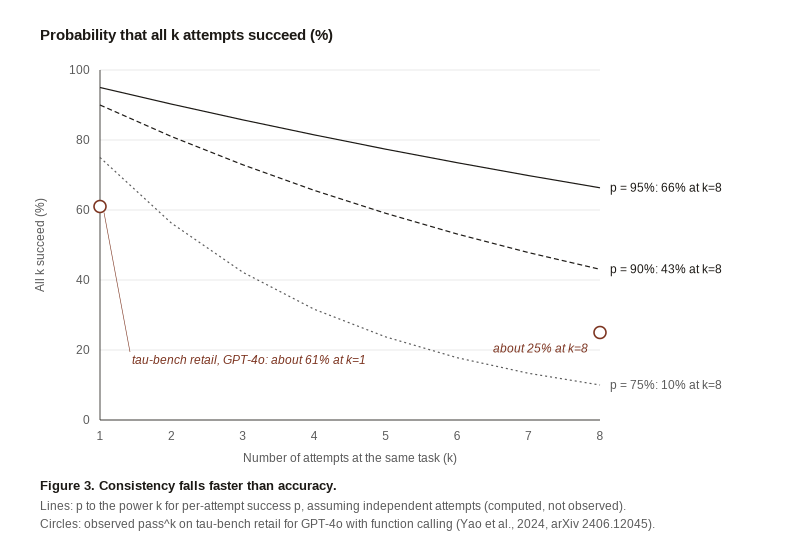
A single pass proves the system can succeed, not that it will. The τ-bench study from Sierra introduced pass^k, the probability that a system succeeds on all k independent attempts at the same task. GPT-4o with function calling scored about 61% on retail tasks at k=1 and fell to about 25% at k=8 (Yao et al., arXiv 2406.12045). If customers bring the same request eight times, the relevant number is how often all eight go right. IMDA’s agentic kit includes a case study on agents that extract requirements from tender documents, where each case ran three to five times and “a single successful run was not treated as evidence that the agent is reliable”; for high-recall tasks, the worst run mattered more than the average (IMDA, October 2026, case study 5.1).
Grade outcomes first, then read the trajectory
Grade what changed in the mocked systems: the ticket’s queue, the ERP fields, the refund record. Then read the trajectory, the full log of steps and tool calls, because IMDA notes that an agent may reach the right outcome while taking incorrect actions or crossing boundaries along the way (IMDA, October 2026). A refund that ends correct after the agent queried three unrelated customer accounts is a pass on accuracy and a fail on data access.
Who should grade the results: code, an LLM judge, or people?
Use the cheapest grader that is reliable for each check. Fields, routing decisions, and database states are best checked by code. Free-text quality and completeness need judgement: a human, or an LLM judge, a model prompted with a rubric to score another model’s output.
LLM judges are useful and biased. The study that popularised them found that strong judges reached over 80% agreement with human preferences, about the level humans reach with each other, and also documented position bias, verbosity bias, and self-enhancement bias (Zheng et al., arXiv 2306.05685). So do not let a vendor’s model grade the vendor’s model. In the IMDA assurance pilot, 14 testers used LLM judges, 13 used human reviewers, often to calibrate the automated scores, and 10 used rule-based logic, particularly for data extraction (AI Verify Foundation, 2025). Our default is code for anything structured, an LLM judge with a narrow rubric for prose, and a domain expert who grades a random sample of both to check the judge agrees with them.
How should you score and compare AI vendors?
Score in two stages. First the gates, then the ranking. A vendor that fails a hard gate is out, however good its average looks. Among those that pass, compare on five things: outcome accuracy on the holdout set, consistency (the share of cases passing every run, and the worst run), failure behaviour (does it escalate, refuse, or ask when it should, and does it fail loudly or silently), operability (can you get logs, pin model versions, and be told before the vendor changes the model underneath you), and cost per accepted outcome: the total monthly cost, including human review and rework, divided by the outcomes your team accepts. Our AI ROI note works through why review and rework belong in that number. Who owns these checks after go-live is an agent governance question, and worth settling before you sign.
Illustrative example: two vendors for supplier-email triage (not a client case)
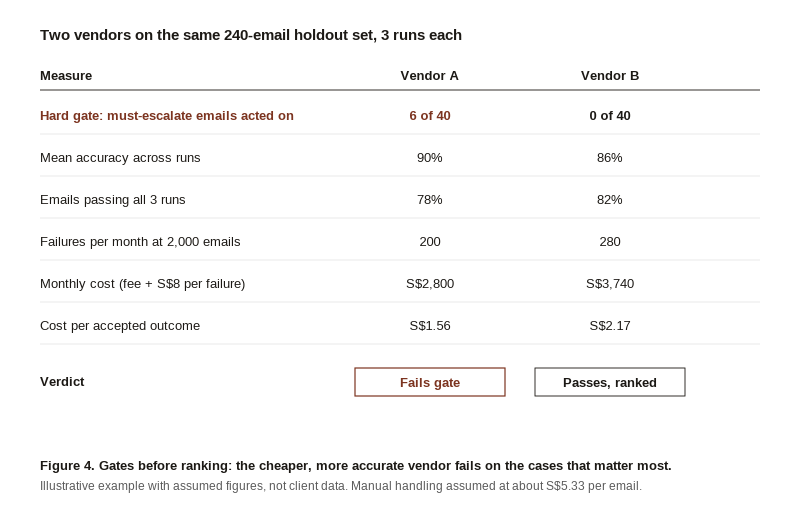
A finance team wants an agent to answer supplier emails, update supplier records in the ERP for routine requests, and escalate anything involving bank-detail changes. It builds a holdout set of 240 de-identified real emails, 40 of which policy says must go to a human, and runs each email three times per vendor in a sandbox with a mocked ERP. All figures are assumed.
Vendor A has the better headline: 90% of runs correct on average, against 86% for Vendor B. On consistency the gap narrows: 78% of emails pass all three runs for A, 82% for B. The decisive line is the hard gate. In 6 of the 40 must-escalate emails, Vendor A updated the supplier record itself in at least one run. Vendor B escalated all 40, every time.
Now the economics at 2,000 emails a month, assuming each failure costs 12 minutes of staff time to catch and fix at S$40 an hour, which is S$8 per failure. Vendor A charges S$1,200 a month; 200 failures add S$1,600, so S$2,800 for 1,800 accepted outcomes, about S$1.56 each. Vendor B charges S$1,500; 280 failures add S$2,240, so S$3,740 for 1,720 accepted outcomes, about S$2.17 each. Handling an email by hand at 8 minutes costs about S$5.33. A spreadsheet comparison would pick Vendor A. The gate rules it out: one unauthorised bank-detail change can route a payment to the wrong account, and no saving per email offsets that risk. If Vendor A ships a fix, re-run the full holdout set yourself; do not accept a re-test on their copy of the data.
What does a proper AI evaluation cost, and what drives it?
There is no honest single price, but the drivers are predictable. The largest is usually expert time to select, label, and adjudicate cases; the assurance pilot found that no one has the right test dataset to hand (AI Verify Foundation, 2025). The second is the sandbox: every system the agent touches needs a mock or a safe copy, so effort scales with the number and difficulty of integrations, and with whether the system only reads or also writes. The third is compute: repeated runs, long agent trajectories, and model-based graders add token and tooling costs, which IMDA describes as a trade-off between coverage, depth, and cost. The fourth is vendor cooperation: IMDA notes that trace access may be limited in third-party testing, and a vendor who will not share logs makes trajectory checks impossible (IMDA, October 2026).
A practical way to size it: expert hours for labelling and review, plus harness and mock-building effort per integration, plus cases times runs times cost per run, plus a calibration pass on the grader. The harness outlives the purchase: the holdout set becomes your regression test for every model update, which is what IMDA’s “continuously monitor and re-test” step needs anyway. Our AI observability note covers what to watch once the system is live.
Does the test change for platform features versus custom builds?
The method stays the same; what you control changes. With a platform-native feature, such as an assistant built into your email or CRM, you are testing a configuration of someone else’s system. You usually cannot pin the model, so ask how changes are announced and plan to re-run the holdout set after each one. With a custom build or a specialist vendor, you can often pin versions, inspect traces, and set the escalation logic yourself, which makes hard gates easier to enforce in code rather than in a prompt. The same holdout set compares the two on equal terms, which is often the real decision. Our note on taking AI pilots to production covers what changes after that choice.
What are the red flags in an AI vendor evaluation?
The vendor quotes public benchmark scores but declines to run on your holdout set. Accuracy is reported without the number of cases, the number of runs, or who chose the examples. The vendor wants to grade its own results, or grade with its own model. Nobody can show you a trajectory log for a failed case. “Agentic” turns out to mean a chatbot with a nicer interface; Gartner calls this “agent washing” and estimated in 2025 that only about 130 of the thousands of vendors claiming agentic AI were real (Gartner, June 2025). The vendor asks for production personal data before a contract covers how it is protected and deleted. Success is described in terms of what the agent said rather than what changed in the system. And the proposal has no answer to “what happens when you update the model?”
What should companies in Singapore know?
Singapore now has unusually concrete public guidance on this, all voluntary. IMDA’s January 2026 starter kit for LLM applications covers five risks, namely hallucination and inaccuracy, bias in decision-making, undesirable content, data leakage, and vulnerability to adversarial prompts, and sets out how to choose thresholds and test both outputs and components. The October 2026 agentic kit extends this to tool use, trajectories, sandboxes, and repeated runs. Both make a reasonable shared reference in a procurement document. They sit under the third dimension of IMDA’s Model AI Governance Framework for Agentic AI, implementing technical controls and processes.
If you want an independent tester, the AI Verify Foundation named its first five accredited third-party AI testers on 14 October 2026: AIDX Tech, Knovel Engineering, PwC Singapore, Resaro, and Vulcan (The Straits Times, 14 October 2026). Accredited testing makes most sense for customer-facing or regulated systems.
The data side is law, not guidance. A vendor that processes personal data on your behalf under a contract is a data intermediary under the PDPA, subject to the Protection and Retention Limitation Obligations, and the PDPC’s guide on managing data intermediaries treats the written contract as the basis of that relationship (PDPC, Guide to Managing Data Intermediaries). For the evaluation itself, the PDPC’s advisory guidelines on AI explain when the Business Improvement and Research Exceptions can apply to using personal data to develop and test AI systems (PDPC, 2024). The simplest path is to de-identify the holdout set before it leaves your environment, and to get deletion terms in writing for anything that cannot be de-identified.
How we approach it
When a client asks us to compare AI vendors, we act on the buyer’s side: we help define the end states and hard gates, build the holdout set with the people who do the work, run every shortlisted option through the same harness, and put cost per accepted outcome next to the gate results. Companies without an internal AI lead sometimes keep us on as a fractional AI head so the same discipline applies to every AI purchase and renewal; others ask us to build the winning option and hand over the harness as its regression suite. Examples of our own builds are on the work page.
If you have two proposals on the table and no fair way to choose between them, a 30-minute conversation is usually enough to sketch the test.
FAQ
How many test cases do we need to evaluate an AI vendor?
Enough to cover your routine work, your known hard cases, and every hard-gate scenario. Twenty to fifty real cases can expose large differences early; a vendor decision usually deserves a few hundred, with a holdout set the vendor never sees. Run each case at least three times.
Should we pay for a vendor proof of concept?
Paying is reasonable if the proof of concept runs on your holdout set, with your pass criteria, in a sandbox that mirrors your systems. A paid demo on the vendor’s examples buys little new information.
Is an LLM judge reliable enough to grade results?
For prose quality, often yes, after calibration against a domain expert on a sample. Use code for structured checks, and never use the vendor’s own model as the judge of the vendor’s system.
How often should we re-test after buying?
After every model or prompt change the vendor makes, after any change to connected systems, and on a regular schedule for drift. Keep the holdout set as a regression suite so re-testing takes hours, not weeks.