RAG vs Fine-Tuning vs Prompting vs Agents: Which AI Pattern Fits Your Business?
Fine-tuning is only one option. Learn when to use RAG, prompting, fine-tuning, agents, or a hybrid architecture for business AI workflows.
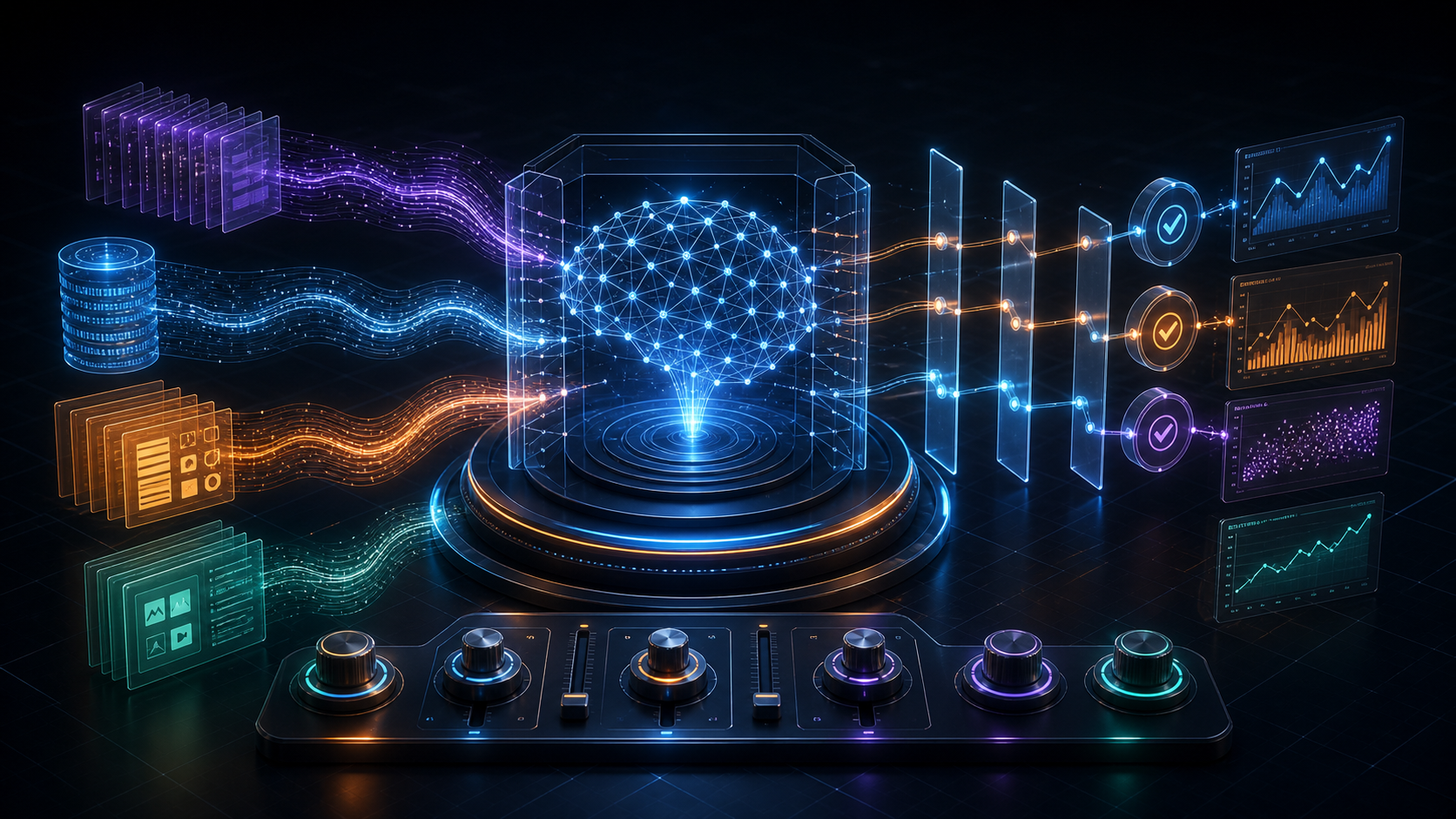
Business teams often ask whether they should use prompting, RAG, fine-tuning, or agents. The better question is: what does the workflow need to do, what information does it need, what risk does it create, and how will success be measured?
Fine-tuning is useful, but it is rarely the first answer. Most production AI systems combine several patterns: strong prompts, retrieval, structured tools, evaluation, routing, and sometimes fine-tuned or private models. Choosing the wrong pattern can make a system more expensive, harder to govern, and less reliable.
The Four Common Patterns
Most business AI architectures start with one or more of these patterns:
- prompting: instructions, examples, schemas, and guardrails around a general model
- RAG: retrieval-augmented generation that brings trusted documents into the model context
- fine-tuning: training a model to improve task behavior, format, style, or domain performance
- agents: workflows where the model plans, calls tools, observes results, and completes multi-step tasks
These are not competitors in every case. They solve different problems.
Use Prompting When the Task Is Stable and Lightweight
Prompting is the right starting point when the model already has the capability and you mainly need better instructions, examples, tone, or output structure.
Good fit:
- summarizing standard documents
- drafting routine emails
- extracting fields from simple text
- classifying common requests
- rewriting content into a known style
- producing structured JSON from low-risk inputs
Prompting is fast to test and cheap to change. It becomes fragile when the workflow needs fresh company data, complex permissions, multi-step tool use, or strong guarantees across edge cases.
Use RAG When the Model Needs Trusted Knowledge
RAG is usually the best next step when the answer depends on private, changing, or source-specific information. Instead of expecting the model to “know” the answer, the system retrieves relevant documents and places them into context.
Good fit:
- policy assistants
- customer support knowledge bases
- technical documentation search
- sales enablement
- contract and proposal support
- internal research assistants
The hard part of RAG is not connecting a vector database. It is designing retrieval quality, permissions, freshness, citation behavior, and context limits. That is why RAG belongs inside a broader context engineering discipline.
Use Fine-Tuning When Behavior, Format, or Efficiency Must Improve
Fine-tuning is useful when examples can teach the model behavior that prompting and RAG do not handle well enough. It can improve consistency, specialized classification, tone, structured output, or performance on repeated domain tasks.
Good fit:
- high-volume classification
- specialized extraction
- strict response style
- domain-specific task behavior
- smaller models for cost or latency
- repeated workflows with strong training examples
Fine-tuning is usually a poor way to store changing facts. If the business problem is “the model needs our latest policy,” use RAG. If the problem is “the model does not reliably follow this task pattern even with good context,” fine-tuning may help.
Use Agents When the Workflow Requires Action
Agents are appropriate when the system must complete a multi-step task, not only answer a question. They may search, retrieve, call APIs, update records, ask for approval, retry failed steps, and escalate exceptions.
Good fit:
- customer support triage
- sales research workflows
- operations coordination
- report generation from multiple systems
- internal IT or HR request handling
- workflow automation with human approval points
Agents need tighter design than chatbots. Teams should define loops, tool permissions, recovery paths, evaluations, and ownership. Start with Loop Engineering and pair it with AI Agent Governance.
A Practical Decision Matrix
Use this simple rule of thumb:
- If the model can do the task but needs clearer instructions, start with prompting.
- If the model needs trusted company knowledge, add RAG.
- If the model needs to act across systems, design an agent workflow.
- If repeated behavior remains inconsistent or too expensive, evaluate fine-tuning.
- If the workflow is high-risk or high-volume, add observability and governance before scaling.
The most common production pattern is hybrid. A customer support agent might use prompts for policy, RAG for knowledge, tools for ticket actions, evaluation for quality, observability for traces, and model routing for cost control.
Evaluate by Workflow, Not by Model Preference
Do not choose architecture based on what is fashionable. Choose it based on workflow evidence.
Measure:
- task success rate
- hallucination and citation quality
- cost per successful task
- latency
- escalation rate
- human correction rate
- policy violations
- maintenance effort
- business value created
For production systems, connect these metrics to AI Observability and AI ROI measurement. Otherwise, teams end up comparing models instead of improving outcomes.
Common Mistakes
Avoid these failure modes:
- fine-tuning before fixing retrieval
- building an agent when a deterministic workflow is enough
- using long prompts instead of structured context
- skipping permissions in RAG
- measuring answer quality without measuring cost
- treating evals as a one-time test
- standardizing on one model for every workflow
Most AI architecture problems are not solved by a single bigger model. They are solved by matching the pattern to the workflow.
How ModelShifts Can Help
ModelShifts helps teams choose the right AI architecture for business workflows: prompting, RAG, fine-tuning, agents, model routing, and hybrid systems. We can audit existing prototypes, identify failure modes, and design a production path that balances value, cost, reliability, and risk.
If your team is deciding between RAG, fine-tuning, agents, or a hybrid architecture, contact us for a practical architecture review.