DeepSeek V4 Fact Check: What Businesses Should Take From the Open-Weight Model Race
DeepSeek V4 is real, open-weight, and long-context. The business lesson is model portfolio strategy, not hype about benchmarks or unverified chip claims.

DeepSeek V4 is no longer just a rumor cycle. DeepSeek’s official release notes say the V4 preview went live on April 24, 2026, with open weights, API access, and a one-million-token context window across official DeepSeek services. The release includes two Mixture-of-Experts models: DeepSeek-V4-Pro and DeepSeek-V4-Flash.
The facts that matter most for business teams are straightforward:
- DeepSeek’s official V4 release lists V4-Pro at 1.6T total parameters and 49B active parameters.
- The same release lists V4-Flash at 284B total parameters and 13B active parameters.
- DeepSeek says both models support 1M context.
- The DeepSeek V4 collection on Hugging Face includes V4-Pro, V4-Flash, and base variants.
- The V4 model card lists an MIT license and links to a technical report.
- DeepSeek’s model card describes more than 32T pretraining tokens, hybrid attention for long-context efficiency, mHC connections, and Muon optimization.
Those are the defensible claims. The less settled story is hardware.
Some reporting has described V4 as optimized for Huawei Ascend infrastructure, and later reporting said a Huawei-led team claimed to have completed full-parameter post-training of V4-Pro on a 1,000-chip Ascend 910C cluster. But that hardware claim should be treated carefully: Tom’s Hardware reported that DeepSeek itself had not commented, and that the claim lacked benchmarks, runtime details, and efficiency comparisons. For a business strategy article, it is safer to say DeepSeek V4 sits inside the broader U.S.-China AI hardware and export-control debate, not that every Huawei-training claim is settled fact.
What DeepSeek V4 Changes
DeepSeek V4 matters because it reinforces a pattern: open-weight models are becoming credible enough to be part of enterprise model strategy. That does not mean every business should run DeepSeek. It means model selection is no longer a simple choice between one frontier API and everything else.
Open-weight models can be useful when a company needs:
- more deployment control
- private hosting
- lower marginal inference cost at scale
- customization
- reduced dependency on a single model vendor
- model inspection and experimentation
- regional or sovereign AI requirements
Closed models can still be better when a company needs:
- strongest general performance
- managed reliability
- faster access to frontier capabilities
- minimal infrastructure work
- vendor-provided safety and compliance features
- simpler procurement
The right answer depends on workload, data sensitivity, performance requirements, cost profile, and operational maturity.
Long Context Is Useful, But Not Magic
The one-million-token context window is one of the most visible V4 features. Long context is valuable because companies want models to reason across large documents, codebases, policies, transcripts, logs, and knowledge repositories.
But long context is not a substitute for information architecture.
Even with large context windows, teams still need:
- retrieval strategy
- source ranking
- context compression
- document permissions
- citation behavior
- cost controls
- evaluation on long-context tasks
Large context makes more workflows possible. It does not remove the need for context engineering.
Treat Benchmarks as Signals, Not Procurement Decisions
DeepSeek claims V4-Pro leads current open models across several reasoning, coding, world-knowledge, and agentic benchmarks. The model card also compares V4 against closed frontier systems. Those results are useful signals, but they should not decide procurement by themselves.
Public benchmarks often miss:
- your domain data
- your workflows
- your latency constraints
- your risk tolerance
- your tool integrations
- your compliance requirements
- your cost per successful task
Use benchmarks to shortlist models. Use internal evaluations to choose models.
Evaluate Total Cost, Not API Price Alone
Open-weight models can reduce API dependency, but total cost includes more than model pricing.
Include:
- GPU or accelerator cost
- engineering time
- serving infrastructure
- monitoring
- security review
- model updates
- evaluation
- fallback models
- incident response
For high-volume, stable workloads, open-weight models can be attractive. For early-stage experiments or low-volume workflows, managed APIs may still be cheaper. The practical discipline is the same one described in AI Cost Control: measure cost per useful workflow outcome, not just token price.
Consider Geopolitical and Compliance Risk
DeepSeek also illustrates that AI model choice is now geopolitical. Companies may need to consider:
- data residency
- export controls
- vendor jurisdiction
- model policy behavior
- customer expectations
- regulatory exposure
- supply-chain resilience
- support availability
This does not mean companies should avoid a model purely because of geography. It means model choice belongs in risk management, not only engineering.
Build a Model Portfolio
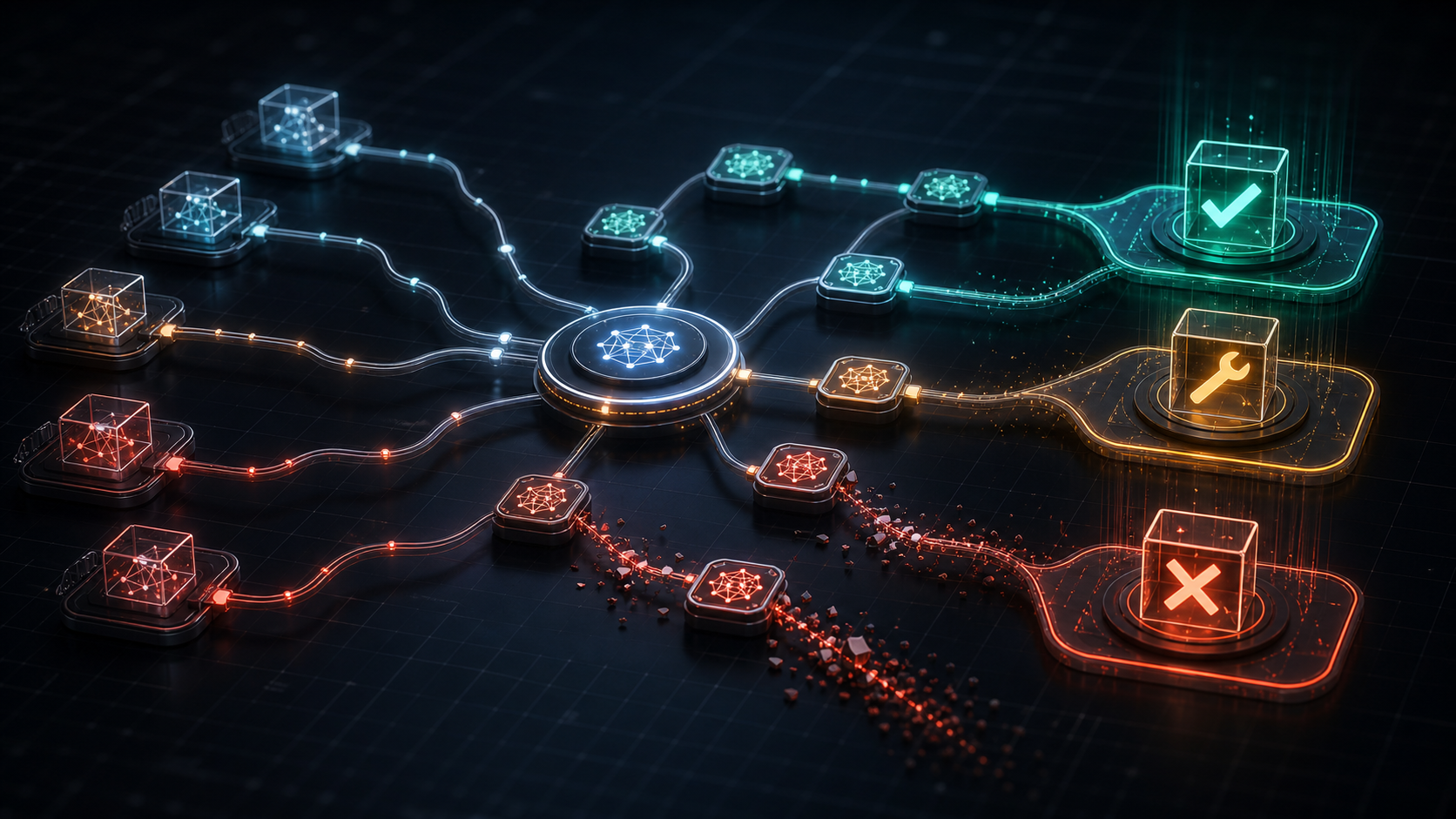
The strongest AI teams increasingly use a portfolio approach. They do not standardize everything on one model.
A portfolio might include:
- a frontier closed model for complex reasoning
- an open-weight model for private or cost-sensitive workflows
- a smaller model for internal classification
- a coding model for developer workflows
- an embedding model for retrieval
- a fallback model for resilience
This approach gives teams flexibility. It also prevents vendor lock-in and lets each workflow use the most appropriate model.
How to Evaluate DeepSeek V4 or Any Open-Weight Model
Use your own tasks, not only public claims.
Test:
- domain accuracy
- instruction following
- refusal behavior
- coding performance
- long-context reliability
- latency
- cost per workflow
- hallucination rate
- privacy requirements
- tool-use reliability
- multilingual performance
- operational support
The best model is the one that performs reliably in your workflow under your constraints.
How ModelShifts Can Help
ModelShifts helps businesses evaluate model strategy across closed APIs, open-weight models, private deployments, and hybrid architectures. We can design evaluation tests, compare cost models, and identify which workflows should use which model class.
If your team is considering DeepSeek, open-weight models, or private AI deployment, contact us to build a practical model-selection roadmap.